FOUR THINGS TO NOTICE
A landscape made by people.
Between Tokyo, Kyoto and Osaka, the view shifts from buildings to farmland and back again. Rice paddies, open fields, tea gardens and greenhouses are different parts of that working landscape.
01 · RICE PADDIES
The same field can look completely different.
A flooded paddy may catch the sky like a little mirror. Young rice makes thin green lines; later, the plants fill the plot. As the crop ripens, the colour turns towards gold. After harvest, you may see stubble or bare soil.
Water helps farmers manage rice growth and weeds. But a paddy is not always flooded: water is also drained during cultivation and for harvesting. A dry-looking plot can still be part of the rice-growing landscape.
A visual sequence, rather than a month-by-month forecast. Region, weather and farming choices change the timing.
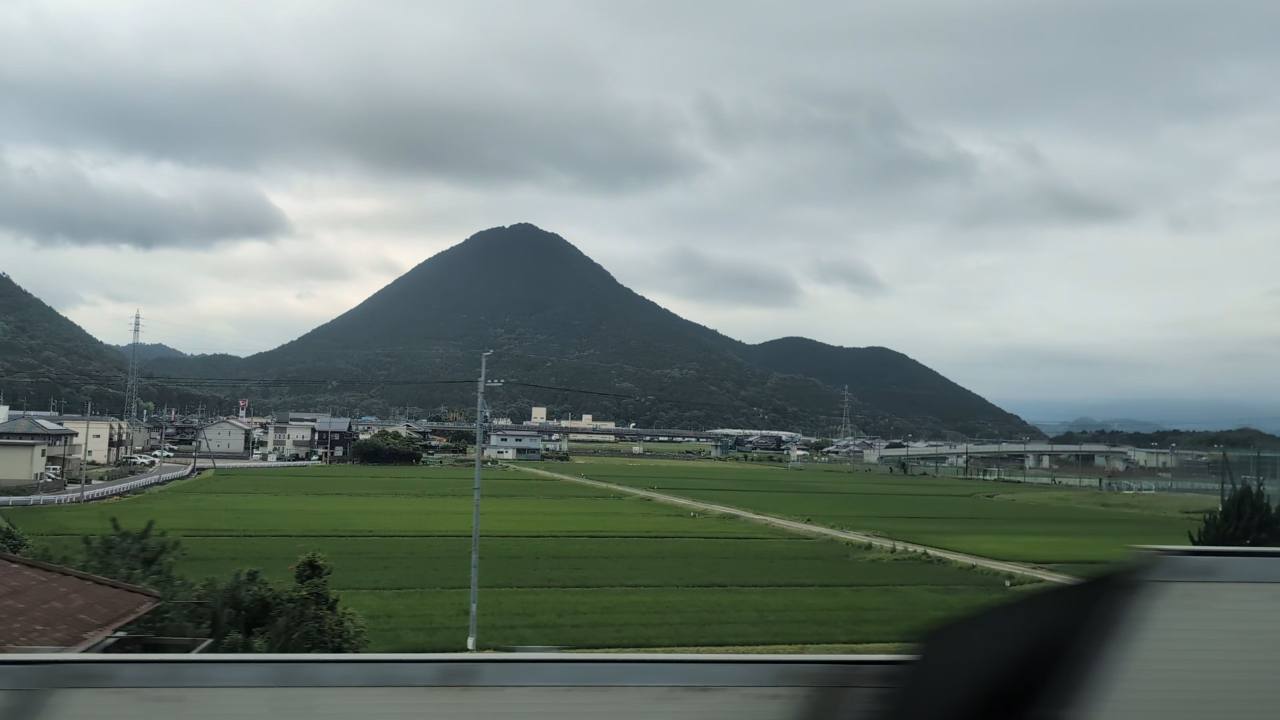
In the opening photograph, green paddies sit below Mount Mikami in Shiga, also called Ōmi Fuji. Look beyond the mountain: paths and low banks divide the foreground into small shapes.
Meet Mount Mikami and its fields02 · OPEN FIELDS
Look for the pattern, before the crop.
Some plots have visible soil between straight rows. Others form broad patches of green or brown. Open fields can grow vegetables and other crops; you won’t always be able to identify them from a moving train.
Notice the spaces between them instead: a narrow road, an irrigation channel, a low bank. The banks around rice paddies are called aze in Japanese and help hold the water. A boundary between two plots does not tell you where one farm ends and another begins.
Look close to the tracks, then towards the hills. How many different patterns can you see in the same view?
03 · TEA GARDENS
The green waves of Shizuoka.
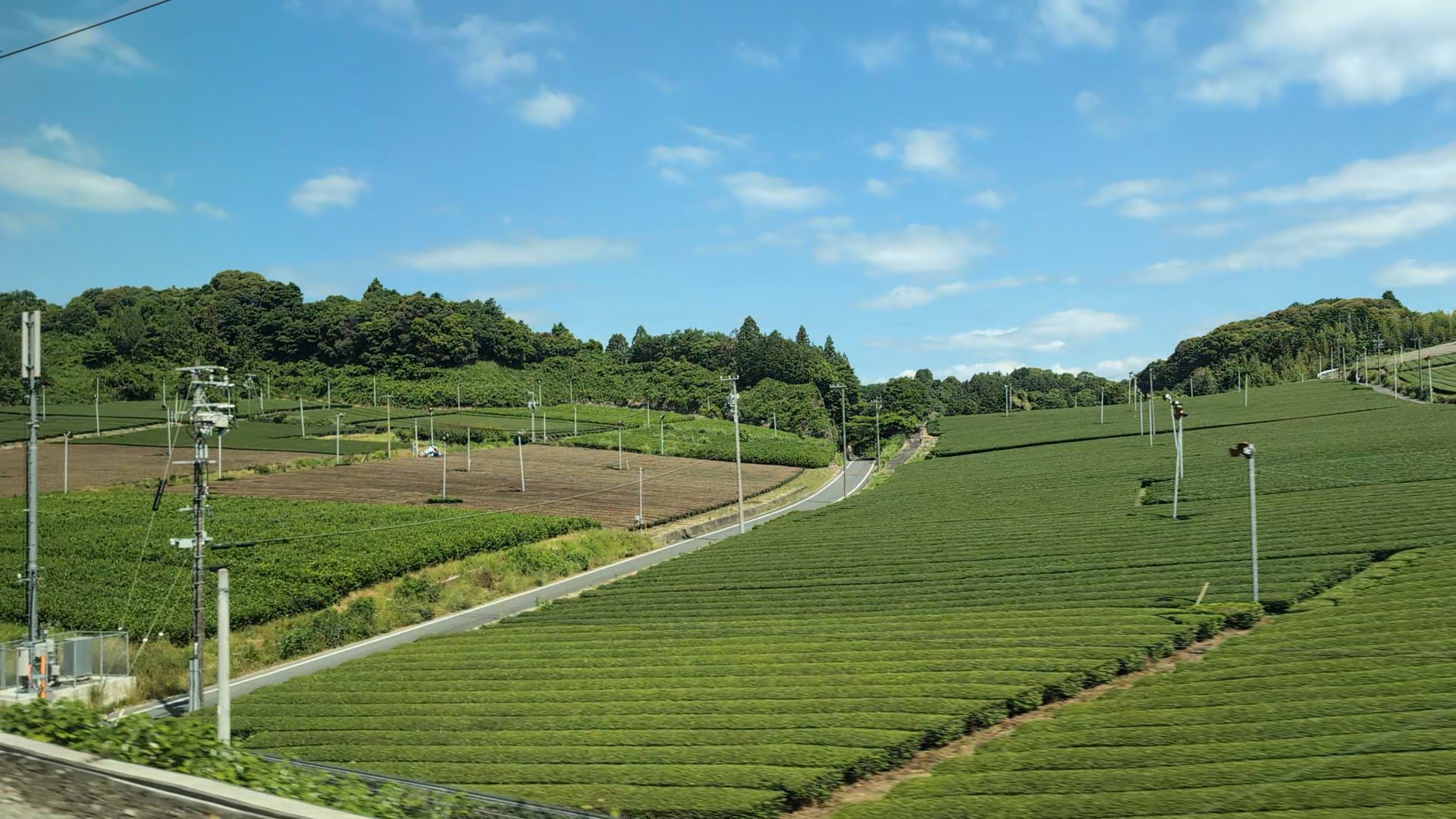
Rounded rows follow the ground like green waves. These are tea bushes, growing in one of Japan’s tea-producing regions. In the photograph, rows of bushes cover the slopes near Kakegawa.
Look for the slender poles with fans above the plants, too. They help protect the tea from frost by moving warmer air down towards the bushes. The little structures are part of the story of those green hills.
A tea bottle with your bento, a cup at your hotel, and a tea garden outside your window: an everyday drink offers another way into the landscape.
04 · GREENHOUSES
Farming beneath the silver roofs.
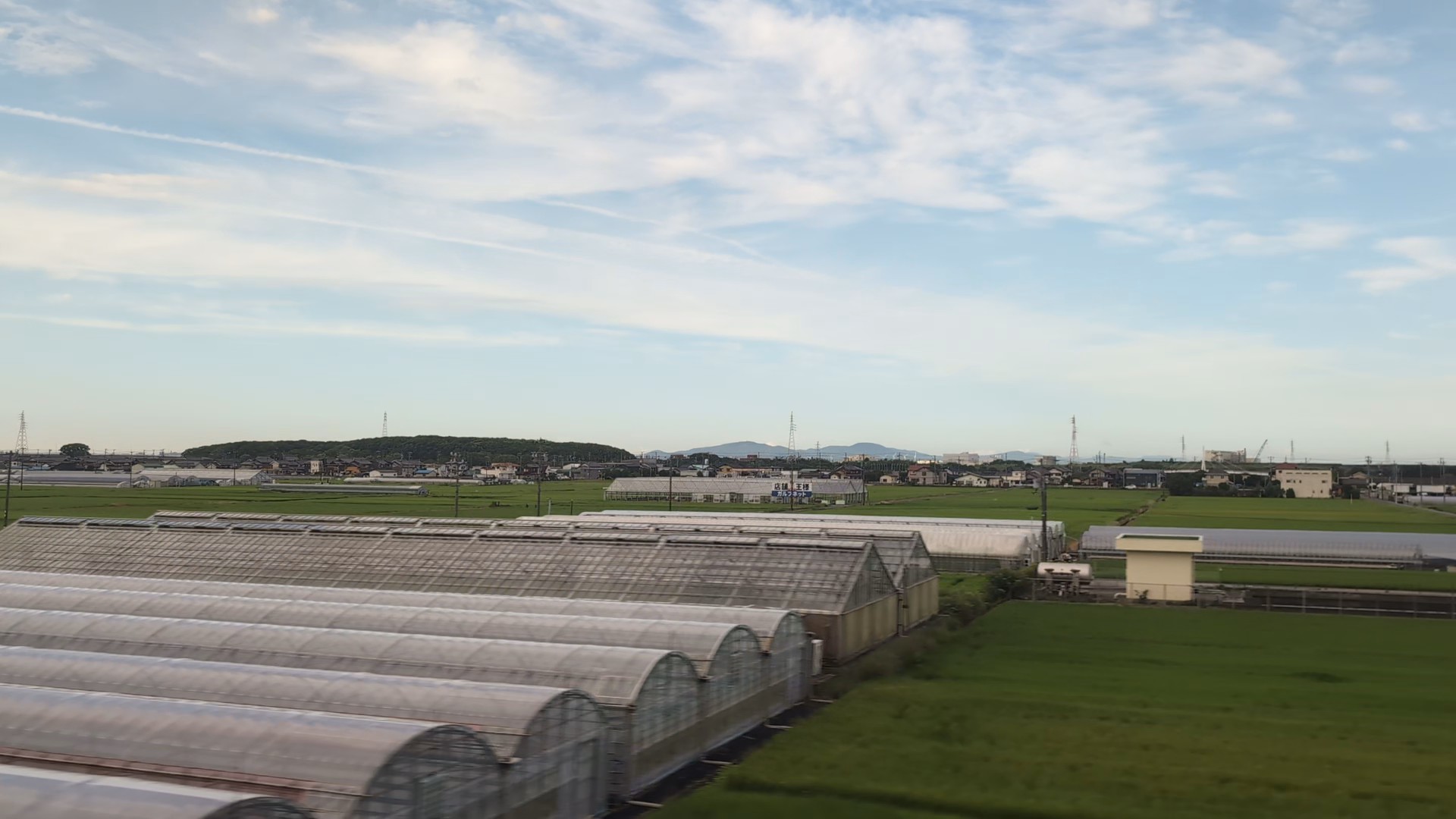
Long, pale roofs appear among the fields. Some are rounded tunnels; others have pointed tops. In Japanese, a plastic-covered greenhouse is often called a vinyl house — ビニールハウス.
The cover helps farmers manage the growing conditions. Greenhouses can grow vegetables, fruit and flowers. A roof alone does not reveal the crop inside, so treat it as the beginning of a question.
This photograph near the Toyokawa Floodway shows curved roofs close to the train and pointed roofs behind them. Around Gamagori, other greenhouses cover parts of the foothills.
Discover the greenhouse landscape →← Everyday Japan · Food, drinks and countryside stories
MORE TO TAKE HOME
Everyday Japan is part of the view.
You may remember a field when you open a bento, or a tea garden when you take a sip. The photograph cannot tell you where your particular meal was grown — it gives you something new to notice.
Enjoy the stories now, or find the seat side and the next view for your own journey.
Reading notes & photographs
Background references checked on 10 October 2026. The viewing prompts are editorial suggestions; crops in individual plots are not identified from distant photographs.
- Rice cultivation and water management · MAFF (English PDF)
- Paddy banks, water and drainage · MAFF (Japanese)
- Tea production · Shizuoka Prefecture (Japanese)
- Tea and frost-protection fans · JA Shizuoka City (Japanese)
- Protected horticulture · MAFF (Japanese)
The photographs show the actual landscape from the train. Locations and dates are given beneath each image.