- Seat side
- North-facing windowsSeat E on 16-car trains. On 8-car trains: Seat D in 2+2 rows, Seat E in 3+2 rows.
- Where to look
- Around Himeji Station
THE STORY
An original Japanese castle, still standing
Himeji Castle is one of Japan’s 12 castles with an original main keep—the central tower of a samurai fortress. Its wooden keep dates from 1609, rather than being a modern reconstruction. The bright white plaster walls gave it the nickname White Heron Castle, after the elegant white bird. From a passing train, you see only a distant silhouette; knowing how much of the old castle survives gives that glimpse a different meaning.
Its story began before that white tower. In 1580, the local lord Kuroda Kanbei handed the castle to Toyotomi Hideyoshi, a military leader who would later unite Japan. Hideyoshi made Himeji a base for his campaigns in western Japan and built an earlier, three-tiered keep. The tower in today’s photographs came later.
After a decisive battle in 1600 helped establish Tokugawa rule, the samurai lord Ikeda Terumasa took charge of this region. He rebuilt Himeji on a grander scale, completing the present main keep in 1609. Three smaller keeps connect to it through covered passages. This was a fortified centre of power as well as an impressive skyline.
There is a family story here too. Princess Sen, a daughter of Japan’s military ruler, the shogun, lost her first husband in the siege of Osaka. She remarried Honda Tadatoki and moved to Himeji in 1617, when his father became lord of the castle. The west enclosure, called Nishi-no-maru, was prepared for the couple. Behind the defensive walls was a place to begin again.
An original castle still needs care. From 1956 to 1964, a major restoration took the keep apart, repaired it and put it back together. Further conservation work led to its reopening in 2015. What looks timeless has survived because people keep maintaining it.
UNESCO recognised Himeji Castle in 1993, in Japan’s first group of World Heritage inscriptions. Its value extends beyond the white tower: gates, walls, smaller towers and moats preserve the layout of an early 17th-century Japanese fortress. Even if you are continuing west without stopping, that cluster of roofs is a small encounter with the world of the samurai.
WHAT TO SEE
Finding it from the window
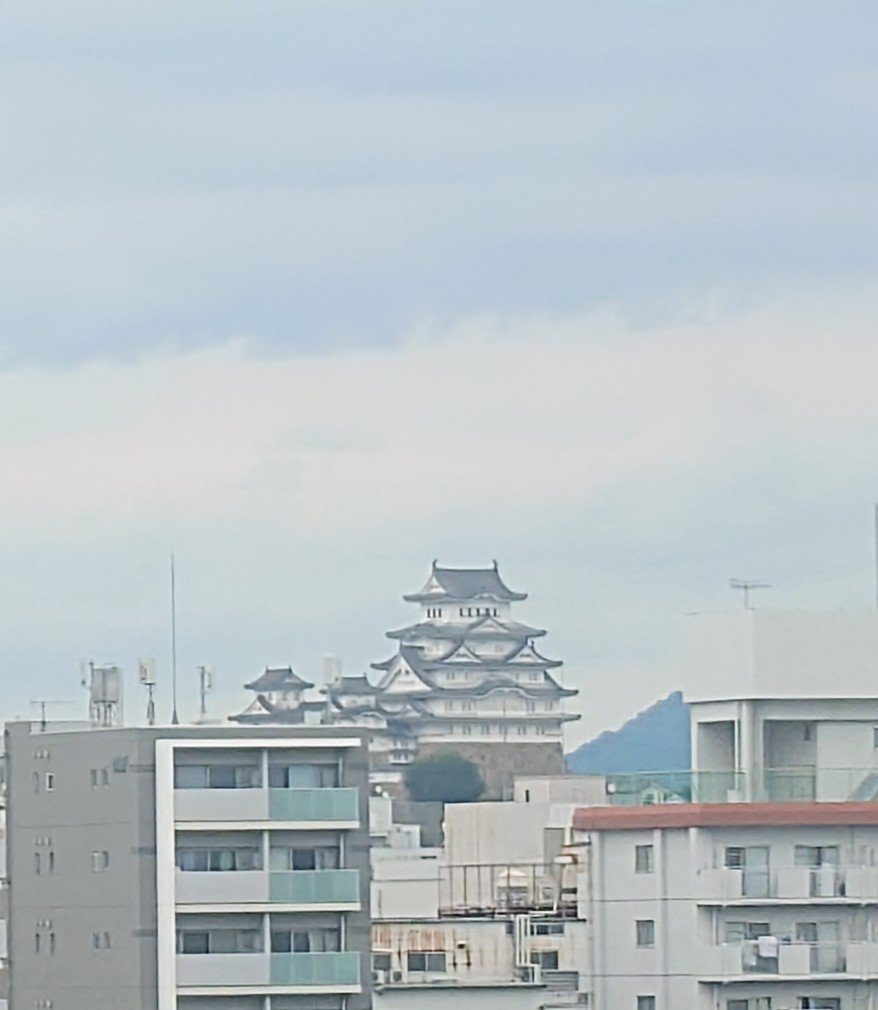
Watch the north side around Himeji Station: the right-hand windows heading west, the left-hand windows heading east. Look for a white silhouette with several overlapping roofs above the city.
About 1.5 km of city lies between the track and the keep. Buildings interrupt the view, and the close-up photograph makes the castle look much larger than it does to the eye. Use the wider view to find its place among the rooftops, and start watching before the station.
PHOTO TIPS
Use the skyline before zooming in
Start with a wide view of the rooftops and look for a cluster of white roofs above them. Switch between the wider photograph and the telephoto close-up to learn both the scale of the castle in the city and the shape of its keep.
For a photograph, waiting with a moderately wide frame can make the castle easier to follow than zooming in tightly as soon as you spot it. Keep watching as foreground buildings interrupt the view, and check for reflections in the glass while remaining comfortably in your seat.
ON THE MAP
The castle and the railway
The train viewpoint is a representative point on the railway, rather than the exact location of each photograph or a visibility boundary.
Open in Google Maps ↗