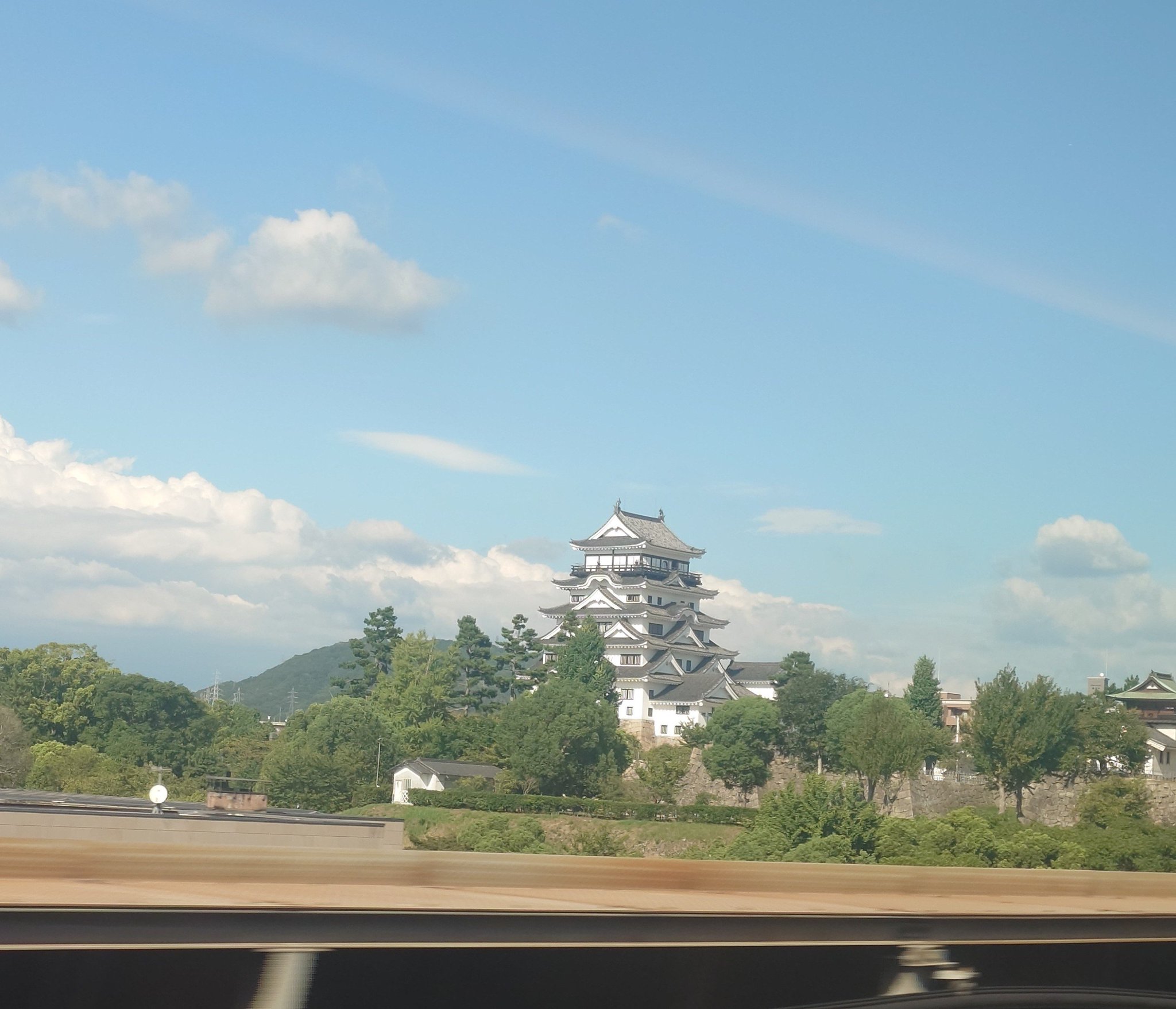
- Seat side
- Seat E sideOn your right westbound, or your left toward Shin-Osaka.
- Where to look
- Right beside Fukuyama Station
THE STORY
A white castle with an iron-clad other side
A white tower appears almost beside your carriage at Fukuyama Station. This is the castle keep, the main fortified tower of a Japanese castle. While Himeji and Okayama are glimpses beyond the city, Fukuyama brings the stone walls and layered roofs close to the railway. The white face you see from the train has a surprising counterpart: an iron-clad north wall hidden on the other side.
Mizuno Katsunari, the first lord of Fukuyama, completed the castle in 1622 after taking charge of the area in 1619. Japan was then governed by the Tokugawa shogunate, the military government based in Edo, now Tokyo. Permission to build a substantial new castle was unusual under its rule limiting castles in each province. Fukuyama was both a seat of local government and a stronghold supporting the shogunate in western Japan.
Decorative gables and white walls give the keep an elegant appearance. Its north side had a different job: the castle boundary was close by, so iron plating strengthened that vulnerable face. Fukuyama City describes this as Japan’s only keep with an iron-plated exterior. The white south face and black north face reveal two purposes of the same tower: displaying authority and preparing for attack.
Some buildings came from Fushimi Castle in Kyoto. One was the Fushimi Turret, a smaller defensive tower. An inscription found on its beams helps establish where it came from. Unlike the rebuilt main keep, this turret survived the 1945 air raid and preserves a building from the castle’s early years. The grounds bring together surviving structures and later reconstructions.
The keep visible today is not the original wooden tower. Fire destroyed it in the 1945 bombing of Fukuyama; donations from residents and businesses helped rebuild it in 1966. The white tower is also a story of a city recovering its familiar landmark after war.
Restoration for the castle’s 400th anniversary in 2022 used historic photographs and other evidence to bring back the iron-plated north wall and the upper floor’s window design. You cannot directly see the black wall from this train-side view. Knowing it is there, however, gives a brief glimpse of white roofs a second layer: a history of defence, loss and restoration behind a station landmark.
WHAT TO SEE
Finding it from the window
Watch the Seat E side beside Fukuyama Station. On a westbound train from Shin-Osaka, that is your right; heading back toward Shin-Osaka, it is your left. Look above the trees for white walls and several layers of roofs on a stone base. Here you are looking close to the station, rather than searching the distant skyline.
Be ready before the train enters the station area. The castle is close to the line, so it can pass before you have time to raise a camera. A train that stops gives a different experience from one passing through; there is no single viewing time that works for every service.
From the railway you see the south side. The iron plating is on the north, behind the keep, so do not wait for a black wall to appear through this window. Find the white tower first, then use the official castle guide to explore the other face.
PHOTO TIPS
Leave room for the stone walls
Use the photograph to recognise the castle, then wait with a moderately wide frame that includes the trees and stone walls. Tight zoom makes a close, moving subject harder to follow. A little space around the keep also shows how unusually near it stands to the railway.
Check for reflections and take photographs comfortably from your seat. If setting up the camera means missing the view, enjoy the tower with your own eyes first. The supplied photo records one train and one moment; scale, light and obstructions can differ on your journey.
ON THE MAP
The castle and the railway
The train viewpoint marks Fukuyama Station, not the position where the photograph was taken or a guaranteed viewing area.
Open in Google Maps ↗