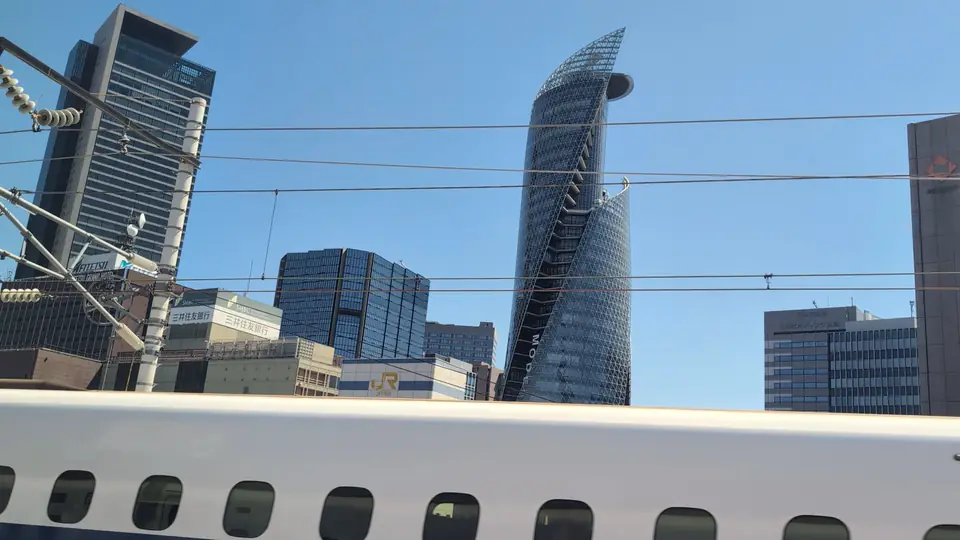
- Area
- Kyoto Station and the Karasuma side
- Seat side
- Seat E for the tower
- Timing
- Around arrival at or departure from Kyoto
- Where to look
- Seat E, near Kyoto StationLook for the top of the tower between buildings. The station square and interior are places to explore after leaving the train.
THE STORY
A white tower and a station that welcome you to Kyoto
As the Shinkansen approaches or leaves Kyoto, look out on the Seat E side for a slender white tower with a round observation room. Beside it, the station building stretches along the tracks, with a hotel and theatre inside. There is something to notice at Kyoto’s gateway before your first temple visit.
Find the tower from the train and watch the station’s long facade come into view. If you get off in Kyoto, head to the north, or Karasuma, side to look up at the tower, then explore the station’s concourse and squares. Seeing the same place from the train and on foot brings its shapes and connections with the city into focus.
BACKGROUND
Near Kyoto Station, turn to the Seat E window
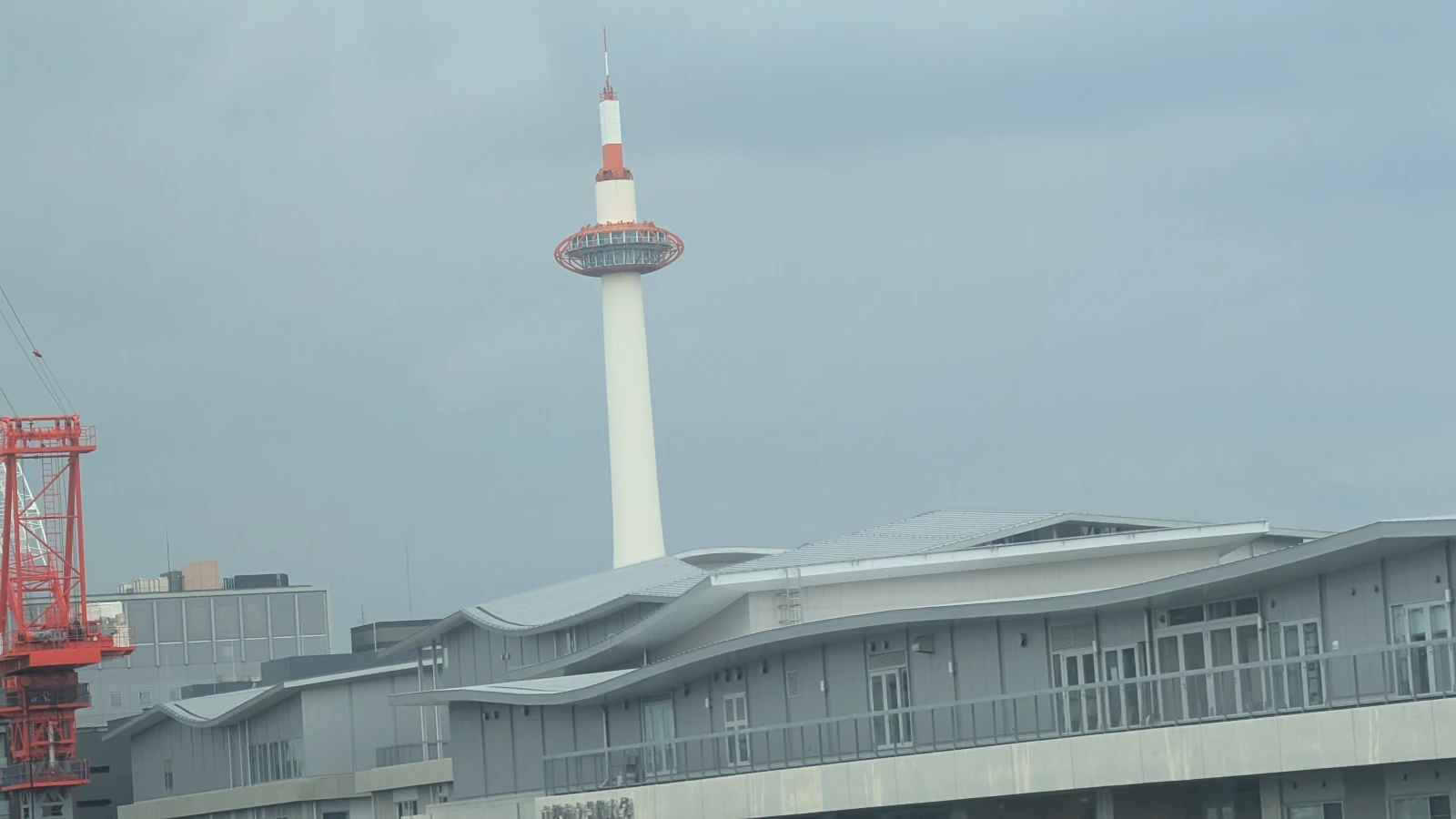
Kyoto Tower stands north of the station, on the Seat E side of the Tokaido Shinkansen. Travelling from Tokyo towards Shin-Osaka, watch before arriving at Kyoto; travelling towards Tokyo, watch after departure. Nearby buildings and platform roofs can hide parts of the tower, so remember its round observation room and red tip first.
In the opening photograph, the white tower rises beyond the wavy roof of Kyoto City University of Arts. In the second view, only the observation room and tip appear above a hotel. As the train moves, the same tower reveals different lengths of its shaft against a changing foreground.
East of the station, the tower and station building can appear in the same window. As you draw closer, the landmark above the city slips behind buildings, while the station’s walls and windows fill more of the view. That brief change is part of the pleasure of arriving.
BACKGROUND
A lighthouse for a city
The 131-metre Nidec Kyoto Tower stands opposite the station’s north, or Karasuma, entrance. Its slender white form represents a lighthouse in a city without a coast. The operator describes Kyoto’s traditional tiled rooftops as waves, with the tower shining over the city.
In the daytime photograph, the white shaft stands clearly against the blue sky and draws your eye up to the round observation room. A form associated with watching over the sea becomes a landmark for people arriving in a city. Knowing that idea gives you a reason to look at the surrounding buildings as well as the tower itself.
After dark, the tower shines above the lights of the buildings and streets. Alongside its usual white illumination, coloured lighting is used for occasions including awareness campaigns. The official site gives information about the day’s lighting.
BACKGROUND
A smooth tower from 1964
The observation room opened on 28 December 1964, the year the Tokaido Shinkansen began running and Tokyo hosted the Olympic Games. Kyoto Central Post Office had previously occupied the site; its relocation opened the way for a new tourism and industry centre.
The architect was Mamoru Yamada, known for buildings that use curves. Instead of a conventional steel frame inside the tower, joined steel plates form a supporting shell. The uninterrupted white surface is connected to how the tower is built.
Look beyond the observation room to the slim shaft below it. The station roof reveals a network of separate structural members, while the tower presents a continuous surface. These two buildings beside the same station offer very different forms to compare.
BACKGROUND
Beside the tower, the station’s long facade
Once you have found Kyoto Tower, lower your gaze. East of the station, the hotel wing and Kyoto Theatre come into view from the train. In the photograph, the theatre’s name, 京都劇場, appears on the grey wall. Rows of hotel windows rise above it, and the tower’s observation room is visible to the right.
This is a station for boarding trains, but it is also a substantial building with places to stay, eat and watch a performance. The rows of windows and broad walls hint at those other parts of city life gathered around a railway gateway.
Another Shinkansen may pass across the foreground. Rather than trying to see the whole building at once, use a detail such as the hotel windows or theatre lettering to get a sense of its scale. The great interior space is something to discover after you get off.
BACKGROUND
A valley under glass
After leaving the train, step into the station building to find a large interior space hidden from the window view. Opened in 1997, this is Kyoto’s fourth station building, designed by Hiroshi Hara. The official design account explains how the street grid of ancient Kyoto informed the plan, with gateways corresponding to Karasuma and Muromachi streets.
The central concourse is imagined as a valley, with terraced spaces extending to the east and west. Glass and metal cover the central space. Follow the view from the people and walkways up to the roof and the scale of this indoor landscape becomes clearer.
A roof can disappear into the background when you are hurrying through. Pause to follow the lines of the structure and the daylight coming through the glass. This is another building shaped by ideas about Kyoto, before the temple visits begin.
BACKGROUND
Step out at Karasuma and compare the views
To walk towards the tower, head for the Karasuma side and Central Entrance on the north of the station. The Shinkansen is on the south side; the north–south public passage connects the two. The tower’s official two-minute walk starts at the north-side JR Central Entrance, rather than at the Shinkansen platform.
Outside, the tower you glimpsed between buildings becomes something to look up at from the street. Let your eye move from the white tower to its neighbours, then turn back towards the station. The long facade seen from the tracks and the large entrance on the Karasuma side give the same building two quite different faces.
For a higher viewpoint, Karasuma-koji Square on the station building’s fourth floor, east side, is one place to see the tower. The tenth-floor Skyway connects the east and west sides along a 185-metre passage, 45 metres above ground. Check the official square guide for current access hours.
By day, notice the tower’s white outline; after dark, its light above the streets. With a little time between journeys, try changing your height and distance around the station. The landmark from your train window becomes a first view to enjoy on foot in Kyoto.
Explore Kyoto Station’s spaces in our Tokyo & Kyoto station guide →
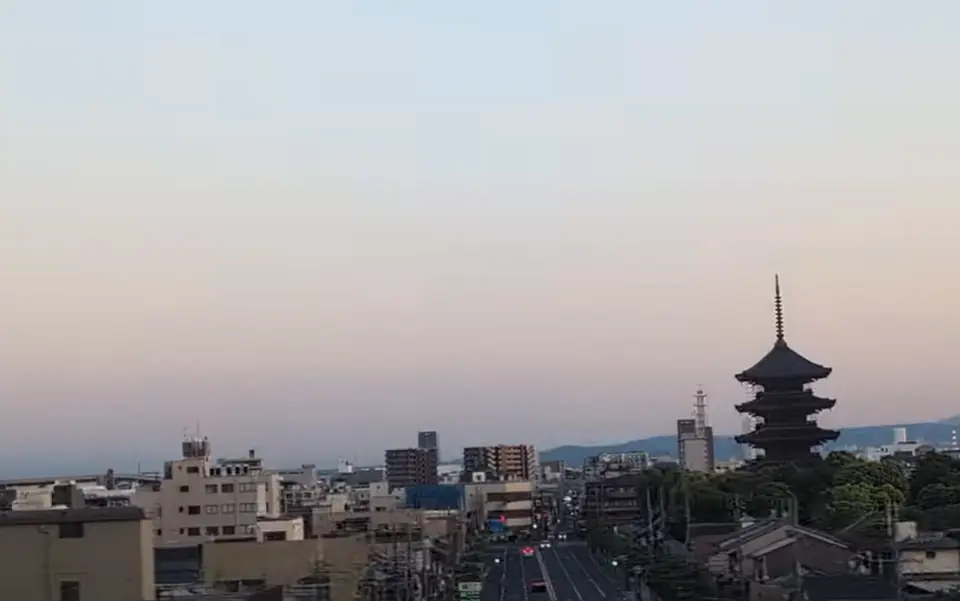
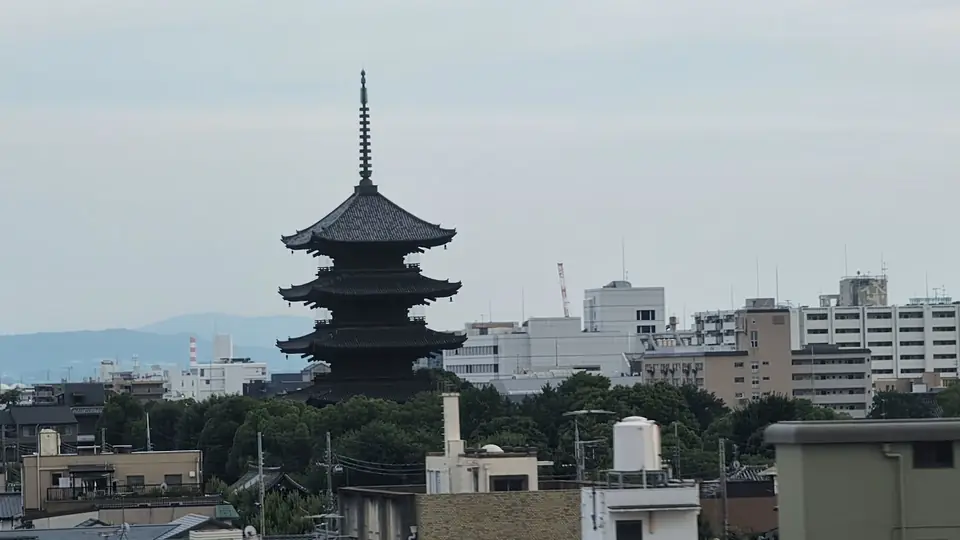
On the other side: To-ji
FURTHER READING
References
Official guidance and window-view records.
- Nidec Kyoto Tower: history, design, structure and lighting (English PDF)
- Nidec Kyoto Tower: station access
- Nidec Kyoto Tower: detailed architecture and lighting information (Japanese)
- Kyoto Station Building: design and history (Japanese)
- Kyoto Station Building: squares and Skyway (Japanese)
- Kyoto Theatre: location and access (Japanese)
- Kyoto City University of Arts: the new campus concept