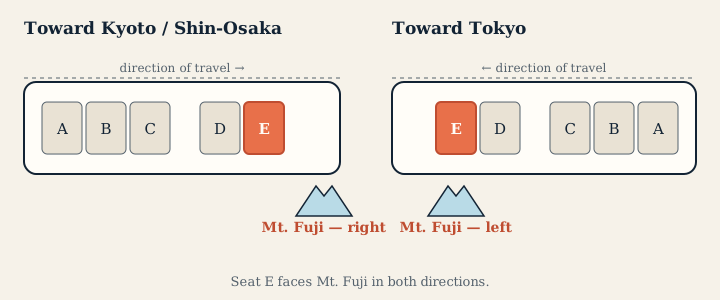
Which side. Heading to Kyoto or Shin-Osaka, Mt. Fuji is on the right — Seat E. Coming back to Tokyo it is on the left, and the seat letter is still E. Seat letters do not change with direction; the mountain simply sits north of the track.
Green Car. The equivalent window seat is Seat D.
How long. Roughly three to four minutes, around Shin-Fuji.
What the pass actually covers
The Tokaido Shinkansen runs three services on the same track, so the view from the window is identical on all three. What differs is how many times you stop, and therefore when you reach Mt. Fuji.
- Nozomi — fastest, fewest stops. Pass holders need a separate special ticket to ride it.
- Hikari — included. A few more stops.
- Kodama — included. Stops everywhere, including Shin-Fuji itself.
Kodama is the slowest way to Kyoto and the best way to see the mountain: it stops at Shin-Fuji, so Mt. Fuji is beside you while the train is standing still.
The slow train is the one that stops where the views are
Several of the best window views sit right beside a station, and the faster your train, the less of them you get. On a Nozomi they are a blur measured in seconds. On a Kodama you are stationary in front of them.
Kakegawa Castle is the clearest case. A white keep a short walk from Kakegawa Station, and in the current timetable 62 Kodama call at Kakegawa while no Hikari and no Nozomi stop there at all. Passing at speed it is a little over ten seconds, split either side of the station. On a Kodama coming into Kakegawa the castle stays in the window for something like half a minute, slipping behind buildings and back out again, and then you are stopped. Odawara Castle works the same way, with Kodama and some Hikari calling at Odawara.
So the trade is not simply slower for cheaper. A Japan Rail Pass puts you on the only trains that stop where several of these views are.
Mt. Fuji times, by train
The tables show scheduled Kodama stops at Shin-Fuji. Hikari trains pass through Shin-Fuji. Their estimated passing times are in the individual train timelines.
Select a train number to open its own window timeline — every view it passes, each with a time and a seat side, worked out from that train’s schedule.
Timetable data updated on
Times are in Japan time (JST). Operating dates and live delays are not reflected. Check the railway operator for your travel date.
Toward Kyoto and Shin-Osaka
Mt. Fuji is on your right, in Seat E.
| Train | From | Departs | At Shin-Fuji | Journey so far |
|---|---|---|---|---|
| Tokyo | 06:30 | 07:39 | 69 min | |
| Tokyo | 06:57 | 08:07 | 70 min | |
| Tokyo | 07:27 | 08:37 | 70 min | |
| Tokyo | 07:57 | 09:07 | 70 min | |
| Tokyo | 08:27 | 09:37 | 70 min | |
| Tokyo | 08:57 | 10:07 | 70 min | |
| Tokyo | 09:27 | 10:37 | 70 min | |
| Tokyo | 09:57 | 11:07 | 70 min | |
| Tokyo | 10:27 | 11:37 | 70 min | |
| Tokyo | 10:57 | 12:08 | 71 min | |
| Tokyo | 11:27 | 12:37 | 70 min | |
| Tokyo | 11:57 | 13:08 | 71 min | |
| Tokyo | 12:27 | 13:37 | 70 min | |
| Tokyo | 12:57 | 14:08 | 71 min | |
| Tokyo | 13:27 | 14:37 | 70 min | |
| Tokyo | 13:57 | 15:08 | 71 min | |
| Tokyo | 14:27 | 15:37 | 70 min | |
| Tokyo | 14:57 | 16:08 | 71 min | |
| Tokyo | 15:27 | 16:37 | 70 min | |
| Tokyo | 15:57 | 17:08 | 71 min | |
| Tokyo | 16:27 | 17:37 | 70 min | |
| Tokyo | 16:57 | 18:08 | 71 min | |
| Tokyo | 17:27 | 18:37 | 70 min | |
| Tokyo | 17:57 | 19:08 | 71 min | |
| Tokyo | 18:27 | 19:37 | 70 min | |
| Tokyo | 18:57 | 20:08 | 71 min | |
| Tokyo | 19:27 | 20:37 | 70 min | |
| Tokyo | 19:57 | 21:07 | 70 min | |
| Tokyo | 20:27 | 21:35 | 68 min | |
| Tokyo | 21:15 | 22:25 | 70 min | |
| Tokyo | 21:45 | 22:48 | 63 min | |
| Tokyo | 22:12 | 23:11 | 59 min |
Toward Tokyo
Mt. Fuji is on your left, in the same Seat E.
| Train | From | Departs | At Shin-Fuji | Journey so far |
|---|---|---|---|---|
| Shizuoka | 06:22 | 06:35 | 13 min | |
| Hamamatsu | 06:20 | 06:56 | 36 min | |
| Shizuoka | 07:02 | 07:13 | 11 min | |
| Hamamatsu | 06:43 | 07:22 | 39 min | |
| Hamamatsu | 06:55 | 07:47 | 52 min | |
| Gifu-Hashima | 06:30 | 08:22 | 112 min | |
| Nagoya | 07:38 | 09:10 | 92 min | |
| Nagoya | 08:08 | 09:41 | 93 min | |
| Nagoya | 08:38 | 10:13 | 95 min | |
| Shin-Osaka | 07:54 | 10:41 | 167 min | |
| Nagoya | 09:38 | 11:10 | 92 min | |
| Shin-Osaka | 08:54 | 11:41 | 167 min | |
| Nagoya | 10:38 | 12:13 | 95 min | |
| Shin-Osaka | 09:54 | 12:41 | 167 min | |
| Nagoya | 11:38 | 13:10 | 92 min | |
| Shin-Osaka | 10:54 | 13:41 | 167 min | |
| Nagoya | 12:38 | 14:13 | 95 min | |
| Shin-Osaka | 11:54 | 14:41 | 167 min | |
| Nagoya | 13:38 | 15:10 | 92 min | |
| Shin-Osaka | 12:54 | 15:41 | 167 min | |
| Nagoya | 14:38 | 16:11 | 93 min | |
| Shin-Osaka | 13:54 | 16:41 | 167 min | |
| Nagoya | 15:38 | 17:11 | 93 min | |
| Shin-Osaka | 14:54 | 17:41 | 167 min | |
| Nagoya | 16:38 | 18:11 | 93 min | |
| Shin-Osaka | 15:54 | 18:41 | 167 min | |
| Nagoya | 17:38 | 19:11 | 93 min | |
| Shin-Osaka | 16:54 | 19:41 | 167 min | |
| Nagoya | 18:38 | 20:13 | 95 min | |
| Shin-Osaka | 17:54 | 20:41 | 167 min | |
| Nagoya | 19:38 | 21:05 | 87 min | |
| Shin-Osaka | 18:54 | 21:41 | 167 min | |
| Nagoya | 20:46 | 22:21 | 95 min |
Riding a Hikari? Open your train's timeline
Open a Hikari train to see its estimated passing time, calculated from its scheduled stops.
Toward Kyoto and Shin-Osaka
- from Tokyo
- from Tokyo
- from Tokyo
- from Tokyo
- from Tokyo
- from Tokyo
- from Tokyo
- from Tokyo
- from Tokyo
- from Tokyo
- from Tokyo
- from Tokyo
- from Tokyo
- from Tokyo
- from Tokyo
- from Tokyo
- from Tokyo
- from Tokyo
- from Tokyo
- from Tokyo
- from Tokyo
- from Tokyo
- from Tokyo
- from Tokyo
- from Tokyo
- from Tokyo
- from Tokyo
- from Tokyo
- from Tokyo
- from Tokyo
- from Tokyo
- from Shin-Yokohama
Toward Tokyo
- from Nagoya
- from Nagoya
- from Shin-Osaka
- from Shin-Osaka
- from Shin-Osaka
- from Shin-Osaka
- from Shin-Osaka
- from Shin-Osaka
- from Shin-Osaka
- from Shin-Osaka
- from Shin-Osaka
- from Shin-Osaka
- from Shin-Osaka
- from Shin-Osaka
- from Shin-Osaka
- from Shin-Osaka
- from Shin-Osaka
- from Shin-Osaka
- from Shin-Osaka
- from Shin-Osaka
- from Hiroshima
- from Okayama
- from Okayama
- from Okayama
- from Okayama
- from Okayama
- from Okayama
- from Okayama
- from Okayama
- from Okayama
- from Okayama
- from Okayama
Before you board
Seat E is the Fuji-side window position in ordinary cars. On a reserved-seat ticket you can choose it in advance; a Japan Rail Pass includes seat reservations on eligible Hikari and Kodama services at no additional charge. Nozomi requires a separate special ticket for pass holders. For current pass conditions and fares, check the official sources: japanrailpass.net and JR Central. If Seat E is sold out, do not go and stand in someone else's row — aim instead for the brief Left-Side Fuji from Seat A, or for Lake Hamana, which works from either side.
If the mountain is hidden
Mt. Fuji is often invisible, and clear winter mornings are by far the best odds. The ride does not end there: the same window carries castles, a lake the train crosses on a low bridge, tea fields, a pagoda in Kyoto, and a few large mysteries that people spend the trip arguing about.